 |
| (My own photo, taken today) |
Rosebay Willowherb - Chamerion angustifolium
Other names for Rosebay Willowherb include: fireweed (in North America), bombweed, singerweed, London's pride, blooming sally, blood vine, cat's eyes (in Shropshire) red ruffer (also a Shropshire name), thunder flower, ranting widow and ramping molly (in Yorkshire).
The name 'Rosebay Willowherb' is dervied from the passing resemblance of the flowers to roses and the leaves to bay leaves and to those of willow tree. The species name of 'angustifolium' means 'narrow leaved', from the Latin angustus meaning narrow and folium meaning leaved.
"And now, high summer –
Your house a withered flower –
The ruins are rank with willowherb,
Your open fireplace gutted, alive
With a rash of pink. A hundred weeds
Spire skyward, their summits flowers
Unbroken, painted magenta."
Your house a withered flower –
The ruins are rank with willowherb,
Your open fireplace gutted, alive
With a rash of pink. A hundred weeds
Spire skyward, their summits flowers
Unbroken, painted magenta."
(From Willowherb by Giles Watson)
It's hard to believe now but this plant was once a rarity in Britain! A once scarce plant that is now so common, it's considered a weed by many people! It's a 'pioneer species', which means the first to colonise a barren area with little competition, and it has spread drastically in the last 150 years. The initial spread of willowherb is thought to have begun as man disturbed the land and created habitats with the building of new railways. The two world wars then resulted in the clearing of forests and lots of burnt/damaged ground in both towns and countryside, creating a lot more suitable habitat and the plant quickly established itself on bomb sites (hence the name 'bombweed').
Rosebay Willowherb is now a very common sight in summer, flowering between June and September. It is very easily recognisable with tall pink flower spikes crowding together along our country lanes, lining footpaths and woodland edges. It can be seen in a wide range of areas - from the coast to cities, from towns and gardens to heathlands and uplands.

I couldn't find a photo in my archives to show the whole plant, perhaps due to the my aversion to all things pink and the fact that I really don't like willowherb so tend not to photograph it! I found the one above here - http://www.geograph.org.uk/photo/197870
The leaves of rosebay willowherb are arranged in a spiral up the stem and are unique in having circular veins which form loops and join together in the outer leaf margins, rather than terminating at the edge of leaf, making this plant very easy to identify at all stages of growth. (You can see this in the photo at the beginning of the post).
Willowherb seeds are dispersed by the wind as the seeds pods are fluffy tufts of hair which act as parachutes. One plant can produce around 80,000 seeds! The plant needs open space and light in order to grow, but seeds can remain viable in the ground for many years and will germinate when the ground is disturbed and opened up to light again.
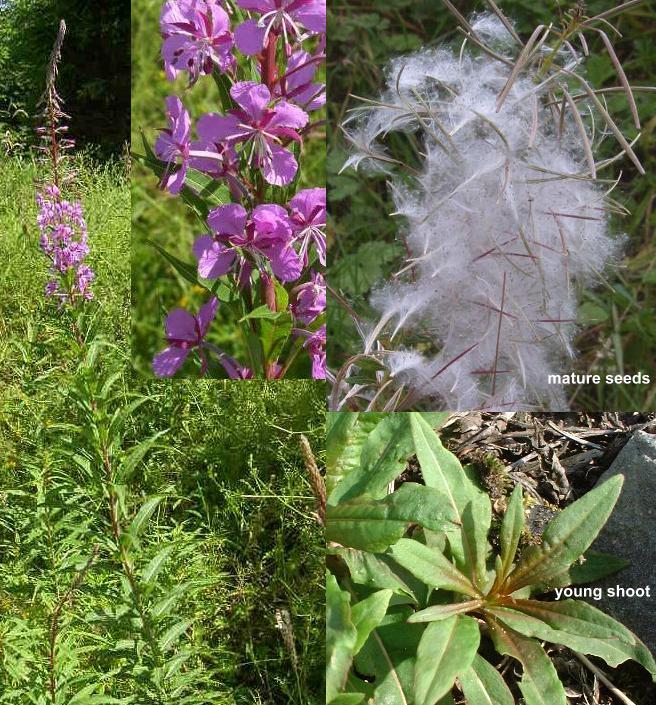
(Not my photo - image source - http://www.downgardenservices.org.uk/rbaywherb.htm)
Rosebay Willowherb is the county flower of London, where there are many local names for it due to its rapid spread across London. It is known as London's Pride or London's Ruin and also as Singerweed, after it colonised the ruins of the Singer sewing machine factory during the war.
Rosebay is a plant of many uses; in Russia, the leaves are used as a substitute for tea, in Alaska it is used to make syrups and jellies and it is also used in Austrian medicine to treat disorders of the prostrate, kidneys and urinary tract and other medicinal uses are, apparently, being investigated. One of my books tells me it is good for soothing digestive problems, much like peppermint tea. The plant has been used as a natural firelighter and to make clothing. The down from the seed heads was used as a mattress stuffing and fibres from the outer stem used to make cord and it is said to have anti inflammatory properties too making it useful for sunburn and nappy rash. It also has edible roots, shoots and leaves and according to Paul Kirtley, Kamchatkan reindeer herders and the North American First Nations consumed the pith from inside the stems – raw, cooked or fermented - details about how to do this are given on his page about rosebay willowherb. It's easy to do and he says quite tasty!
Folklore attached to rosebay willowherb includes that it shouldn't be picked or else a thunder storm will ensue, or because the picker's mother will die. It is also said that it can stop bleeding, heal wounds and drive away snakes, gnats and flies!
Finally, willowherb is, of course, also the food plant of elephant hawk moth caterpillars...


(Ele hawk photos from my own archives, all taken last year)


Thanks for the information, I do like this plant as it is a splash of colour when most things are turning a bit brown with the heat. I did not know it was the food plant for the EHM, so will be taking a closer look...
ReplyDeleteAmanda xx
Great photos of the moth and caterpillar and a super post about the Rosebay Willow Herb. It sounds as if it has lots of uses as well as growing on ruins and railway sidings. I'm never that keen to see it as, like buddleia and bindweed, it is a flower of late summer and reminds me that summer will soon be over:)
ReplyDeleteI'm really enjoying these posts. I didn't know rosebay willowherb was edible - it's given me new respect for it. I'll definitely be looking out for it now if only to try and see those amazing caterpillars! x
ReplyDeleteSuper post and great photos Louise.
ReplyDelete